3D-PAQA
Towards preference-aligned quality assessment for real 3D assets with natural artifacts, criterion-wise diagnosis, and scalable supervision.
Workshops on Image Processing and Image Understanding (IPIU), 2026
Why 3D-PAQA?
Conventional 3D quality assessment often measures controlled synthetic distortions. Real 3D repositories are different: assets vary in geometry, texture, material, plausibility, artifacts, and the quality judgments people actually prefer.
3D-PAQA reframes the task as direct per-asset scoring. Given an arbitrary 3D asset, it predicts a quality vector across human-relevant criteria without a pristine reference or expensive pairwise A/B comparison.
Distortion-centric 3D-QA
- Synthetic degradations
- Reference-oriented fidelity
- Severity of distortion
3D-PAQA
- Natural artifacts
- Human-aligned preference
- Absolute quality of each asset
What the project contributes
New task
3D-PAQA evaluates the quality of an individual 3D asset through a human-aligned quality vector.
Scalable labels
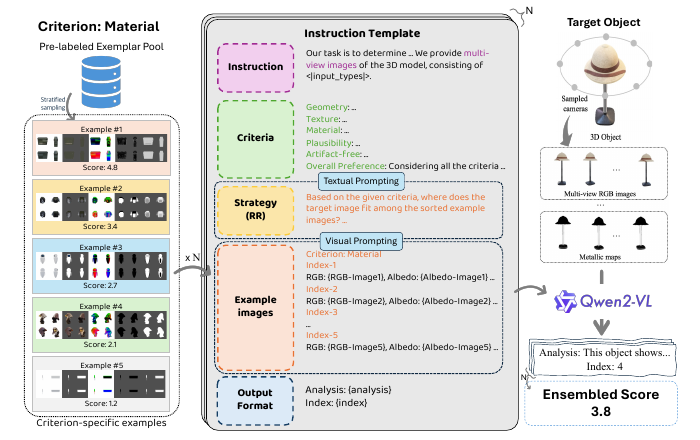
Exemplar anchors and relative ranking turn subjective MLLM judgments into stable large-scale annotations.
Efficient evaluator
A compact 3D-native model predicts criterion-wise quality signals for evaluation and curation workflows.
Refinement reward
The evaluator can also verify an LLM agent's generation loop, steering it to raise an asset's weakest quality criterion over successive iterations.
Qualitative results
Explore examples ranked by criterion. Each row moves from stronger to weaker predicted quality and keeps the paired Ours and human scores from the qualitative analysis.